
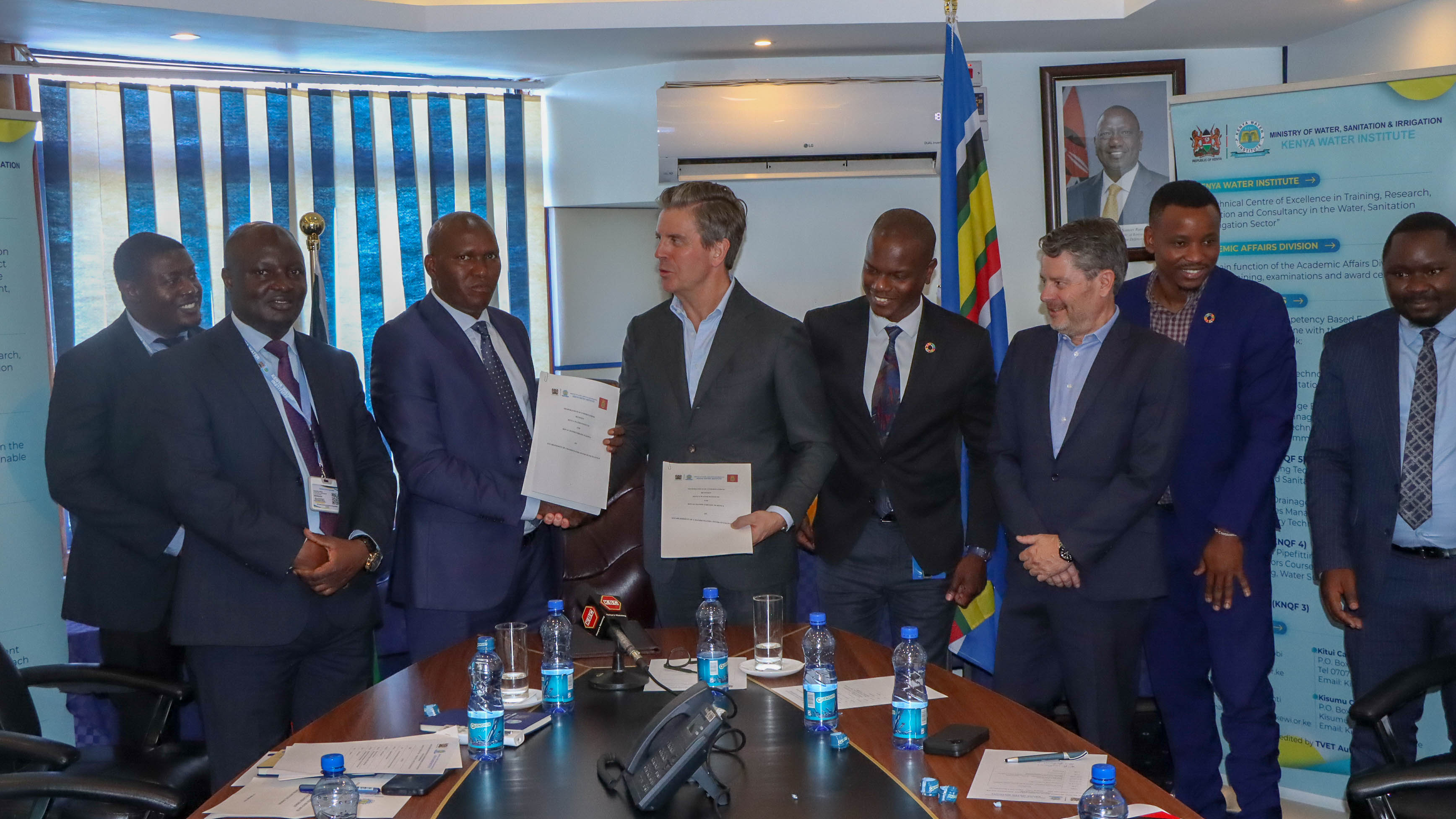
KEWI and Royal Danish Embassy Sign Landmark MoU to Establish Danish Water Centre of Excellence
BY. Britney Mokeira
The Kenya Water Institute (KEWI) marked a historic milestone with the signing of a landmark Memorandum of Understanding (MoU) with the Royal Danish Embassy. The agreement formally establishes a Danish Water Centre of Excellence at KEWI, ushering in another international cooperation aimed at strengthening Kenya’s water, sanitation, and irrigation sectors. The MoU was officially signed by KEWI’s Chief Executive Officer, Dr. Leiro Letangule, EBS, and Denmark’s Ambassador to Kenya, H.E. Stephan Schönemann, in the presence of senior officials and representatives from both institutions.
In his address during the ceremony, Dr. Letangule described the partnership as more than a formal signing, emphasizing that it represents the grounding of a transformative collaboration that merges Danish innovation with Kenyan resilience. He underscored that water remains one of the country’s most critical resources and that sustainable management of this resource is central to Kenya’s development agenda. The establishment of the Danish Water Centre of Excellence is therefore not merely symbolic; it is a strategic intervention designed to bridge longstanding gaps between academic training and industrial application in the water sector.
The Centre will operate as both a physical and knowledge hub within KEWI, where Danish companies and water sector ecosystem actors will showcase cutting-edge technologies, services, and real-world use cases. Through a Danish Embassy–led consortium comprising leading academia, industry players, and technology experts, the Centre will deliver hands-on, industry-aligned training, promote research and innovation, facilitate technology transfer, and advance sustainability and climate resilience initiatives. By integrating Danish hardware and software solutions into KEWI’s training and professional development programs, the partnership seeks to move learning beyond theory to practical, industry-leading precision.
A key highlight of the collaboration is its strong focus on capacity building. KEWI and the Danish Embassy will jointly design and deliver specialized short courses, sector- specific professional training, and consultancy programs addressing water engineering, infrastructure development, governance, and policy implementation. The Centre will also spearhead joint research and technical consultancy assignments to generate evidence-based solutions for water infrastructure management, environmental monitoring, and resource governance. Findings from these initiatives will be documented and disseminated to strengthen policy and regulatory frameworks across the sector.
The MoU outlines a comprehensive framework for cooperation, including policy development and governance support, outreach and public engagement initiatives, and grants and resource mobilization efforts. Together, the parties will implement community forums, stakeholder workshops, and awareness campaigns to elevate public understanding of water quality, sanitation, and sustainability. By aligning KEWI’s mandate in capacity development, research, and innovation with Denmark’s technical expertise and global best practices, the partnership fosters institutional synergy in knowledge exchange and sector transformation.
Dr. Letangule noted that the Centre will fundamentally transform KEWI’s training approach by embedding practical, real-world technologies into curricula, ensuring that graduates possess modern, market-ready skills. He emphasized that this initiative will “future-proof” jobs in Kenya’s water sector by equipping young professionals and technicians with competencies that meet international standards. In parallel, the collaboration supports efforts to formalize the labor market through strengthened assessment and certification mechanisms, bringing recognition and dignity to skilled practitioners.
Ambassador Schönemann reaffirmed Denmark’s commitment to supporting Kenya’s water sector through innovation and expertise. He highlighted that Denmark’s global leadership in water management and green technologies will contribute to shaping stronger curricula, improved governance practices, and more efficient service delivery systems. By facilitating technology transfer and thought leadership through the consortium, Denmark will help accelerate digital transformation and climate resilience within Kenya’s water ecosystem.
The MoU will remain in force for an initial three-year period, with provisions for renewal upon mutual agreement. KEWI has committed to providing dedicated personnel, office space, and infrastructure to operationalize the Centre, while the Danish Embassy will coordinate linkages with consortium partners who will contribute technological tools, curriculum support, and administrative collaboration.
This collaboration aligns closely with Kenya’s broader development priorities, including the Bottom-Up Economic Transformation Agenda (BETA) and national food security objectives, both of which depend heavily on effective water resource management. By building a bridge between Danish technological expertise and Kenya’s local utilities, irrigation schemes, and training institutions, the Danish Water Centre of Excellence is positioned to become a standard-bearer for regional cooperation in the water sector.
Ultimately, the signing of this MoU is a bold and strategic step toward strengthening institutional capacity, enhancing service delivery, and ensuring sustainable access to quality water services for communities across Kenya. Through shared commitment, innovation, and international partnership, KEWI and the Royal Danish Embassy have laid the foundation for a transformative initiative that promises lasting impact for the nation and the region at large.