
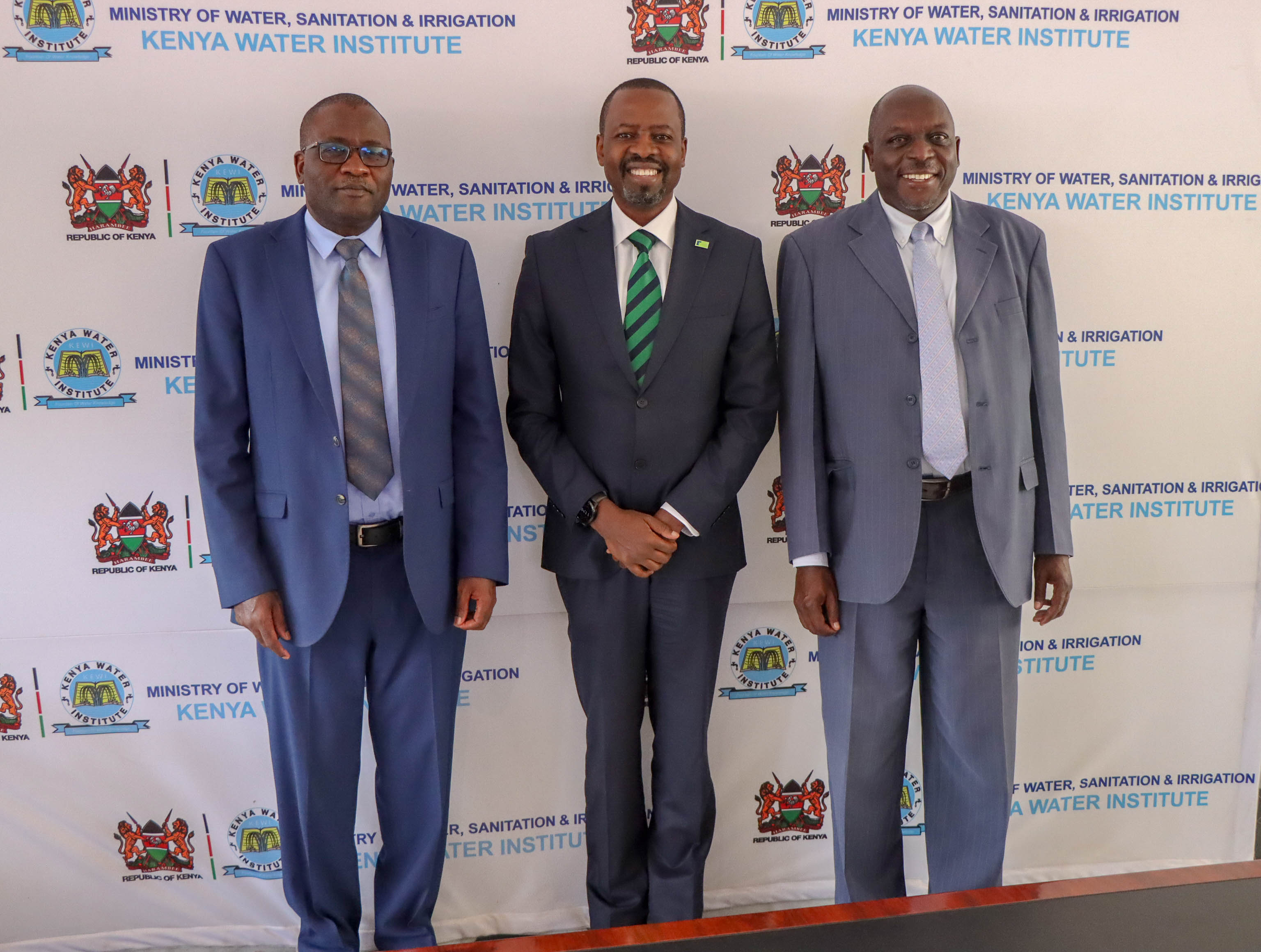
KEWI and KCB Set Stage for Landmark WASH Collaboration
Traditionally, banks have served as financial intermediaries, facilitating payment and transaction services for their customers while focusing largely on expanding their clientele base. However, with growing realization that the sustainability of clients’ sources of income directly influences the growth and stability of financial institutions, banks are increasingly taking a more active role in supporting sectors critical to economic development.
It is against this backdrop that the Kenya Water Institute (KEWI) and KCB Group have initiated discussions on a strategic partnership aimed at addressing pressing challenges affecting the Water, Sanitation and Hygiene (WASH) sector in Kenya.
Speaking during a meeting between officials from the two institutions Mr. Fred Kioko, KCB Group Lead for Strategic Initiatives and Partnerships emphasized that water remains the foundational resource upon which all sectors of the economy depend.
“The ripple effects of this foundational resource impact every sector of the Kenyan economy in distinct ways. Without secure water systems, economies stall and development goals remain out of reach,” he said.
Mr. Kioko, who held discussions with KEWI officials led by Mr. Leonard Makokha, Senior Deputy Director, Academic Affairs noted that the two institutions must jointly explore sustainable interventions within the WASH value chain in order to accelerate efforts aimed at solving longstanding sector challenges.
He observed that increasing population pressure continues to strain existing water resources and infrastructure, making financing a critical component in addressing the issue.
“Water needs to be redistributed to match the ballooning population, and this critical intervention will require huge financing. According to the National Water and Sanitation Investment Plan (NAWASIP), achieving universal water and sanitation access in Kenya by 2030 requires a total of KES 995 billion,” he noted.
With KCB currently serving as a banking partner to more than 40 water service providers across the country, Mr. Kioko said the bank could not remain detached from the challenges facing the sector.
He further identified enhancement of human resource competence within the WASH value chain as one of the most viable interventions under consideration.
“Supporting KEWI in enhancing the competence levels of students who ultimately become our clients will not only lead to entrepreneurial opportunities but will also influence aggressive uptake of water sector career options that will ultimately help cure water sector inefficiencies,” he said.
Welcoming the proposed collaboration, Mr. Eric Wamiti, Senir Deputy Director, Human Resource Management and Administration underscored the need for a revolving fund to support training, incubation of innovations and mentorship of students pursuing water sector solutions.
“Catalysing the intervention by involving our students and staff in co-designing solutions affecting the WASH sector is a sure way of not only enhancing enthusiasm but also creating careers and new SMEs from the knowledge and competencies arising from this collaboration,” he said.
Mr. Makokha noted that for many years the WASH agenda relied heavily on support from non-governmental organizations, a situation he said slowed broader institutional and commercial engagement in the sector.
“We need to do more than just note year in year out the existing financial gap. We need to look at new avenues through which we can address these issues. We need to discover and study niche areas that can generate huge interest and impact,” he said.
Ms. Dorice Situma, Head of Water Resources and Environmental Management Department also supported the establishment of a revolving fund and called for curriculum reconfiguration to better address sector demands.
“Are we practical enough? How innovative are our students and how exposed are they? It is time we faced the issue head-on. We also need to explore possibilities of financing student-led ventures that address WASH challenges such as Non-Revenue Water and support them to maturity,” she said.
Following the discussions, KEWI and KCB Group are expected to finalize and sign a Memorandum of Understanding within the next fortnight to formally establish the partnership and open more areas of collaboration geared towards advancing Kenya’s WASH agenda.