
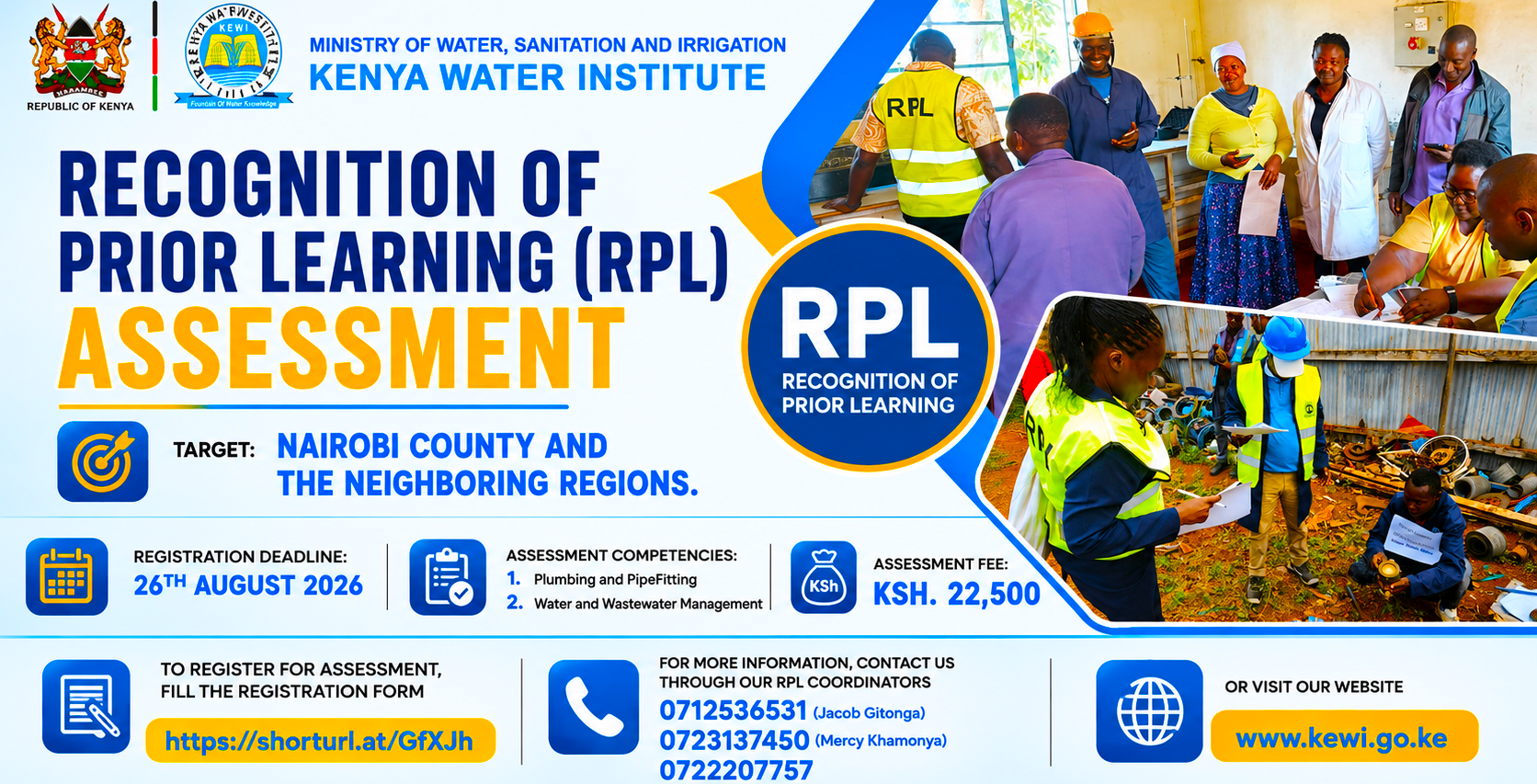
Got The Skills but Not the Qualification? RPL Can Help Turn Experience into Recognition
At the Kenya Water Institute (KEWI), the value of practical skills and experience in Kenya’s water and sanitation sector is well understood. Across the country, thousands of workers have built valuable expertise through years of hands-on work, apprenticeships, informal training and continuous problem-solving in the field. Pump technicians, plumbers, water treatment operators, artisans and other technical practitioners have acquired competencies that are essential to the operation and maintenance of water and sanitation infrastructure.
However, despite possessing valuable practical skills, some of these workers may lack formal qualifications that demonstrate their competencies. This gap between practical experience and formal certification can affect employability, career progression and access to further education and training. It is against this backdrop that Recognition of Prior Learning (RPL) provides an important pathway for experienced practitioners to have their skills formally assessed and recognized.
RPL is a structured process through which knowledge, skills and competencies acquired through work experience, informal training, apprenticeships, self-directed learning or other life experiences are assessed against the standards of a specific qualification. It gives individuals an opportunity to demonstrate what they know and can do, regardless of when, where or how the learning was acquired.
Importantly, RPL means that experienced practitioners do not necessarily have to begin training from the start where they can demonstrate that they already possess the required competencies. Depending on the assessment outcome, a candidate may be awarded a full qualification or recognized for particular components of a qualification, while identified gaps can be addressed through appropriate training.
The importance of such recognition is particularly significant in the water and sanitation sector, where technical competence is central to service delivery. From installing and maintaining water infrastructure to operating treatment systems, repairing equipment and managing wastewater facilities, experienced workers play a critical role in ensuring that essential services function effectively.
For a plumber who has spent years installing and repairing water systems, a technician experienced in maintaining pumps, or an artisan who developed expertise through an apprenticeship, RPL provides an opportunity to have those competencies formally recognized. A recognized qualification can strengthen employability, support career advancement and open pathways to further education and professional development. It can also give employers greater confidence in the capabilities of their workforce while contributing to the wider professionalization of the sector.
The RPL journey begins with counselling and facilitation, during which candidates are guided on eligibility, the appropriate qualification and the competencies against which they will be assessed. Candidates then submit an application and prepare a Portfolio of Evidence (PoE), which forms an important part of demonstrating their prior learning.
The portfolio may contain evidence of work undertaken, completed courses and professional development, self-directed learning, as well as references from supervisors, clients, colleagues or other persons able to verify the candidate’s competencies. An RPL assessor reviews the submitted evidence against the relevant competency standards and learning outcomes.
Where the evidence demonstrates the required competencies, the candidate proceeds to practical assessment at an accredited assessment centre. This provides an opportunity to demonstrate actual skills and competence. Where gaps are identified, candidates may be guided towards appropriate skills-gap training or other suitable pathways to strengthen their abilities.
The process also provides avenues for fairness and accountability. Candidates who are dissatisfied with an assessment outcome have the right to appeal, ensuring that the assessment process remains transparent and responsive.
As a specialized institution in water and sanitation training, KEWI is well positioned to support skills recognition and professional development within the sector. Through RPL, experienced practitioners can demonstrate competencies gained over years of practical work while identifying areas where additional learning may be necessary.
RPL is therefore not a shortcut to a qualification; it is a structured process of identifying, evidencing, assessing and recognizing existing competencies. For Kenya’s water and sanitation sector, it offers an opportunity to bridge the gap between what experienced workers can do and what their qualifications demonstrate, turning years of practical experience into recognized competence and creating pathways for professional growth.