
WATSAN 2026
WELCOME TO
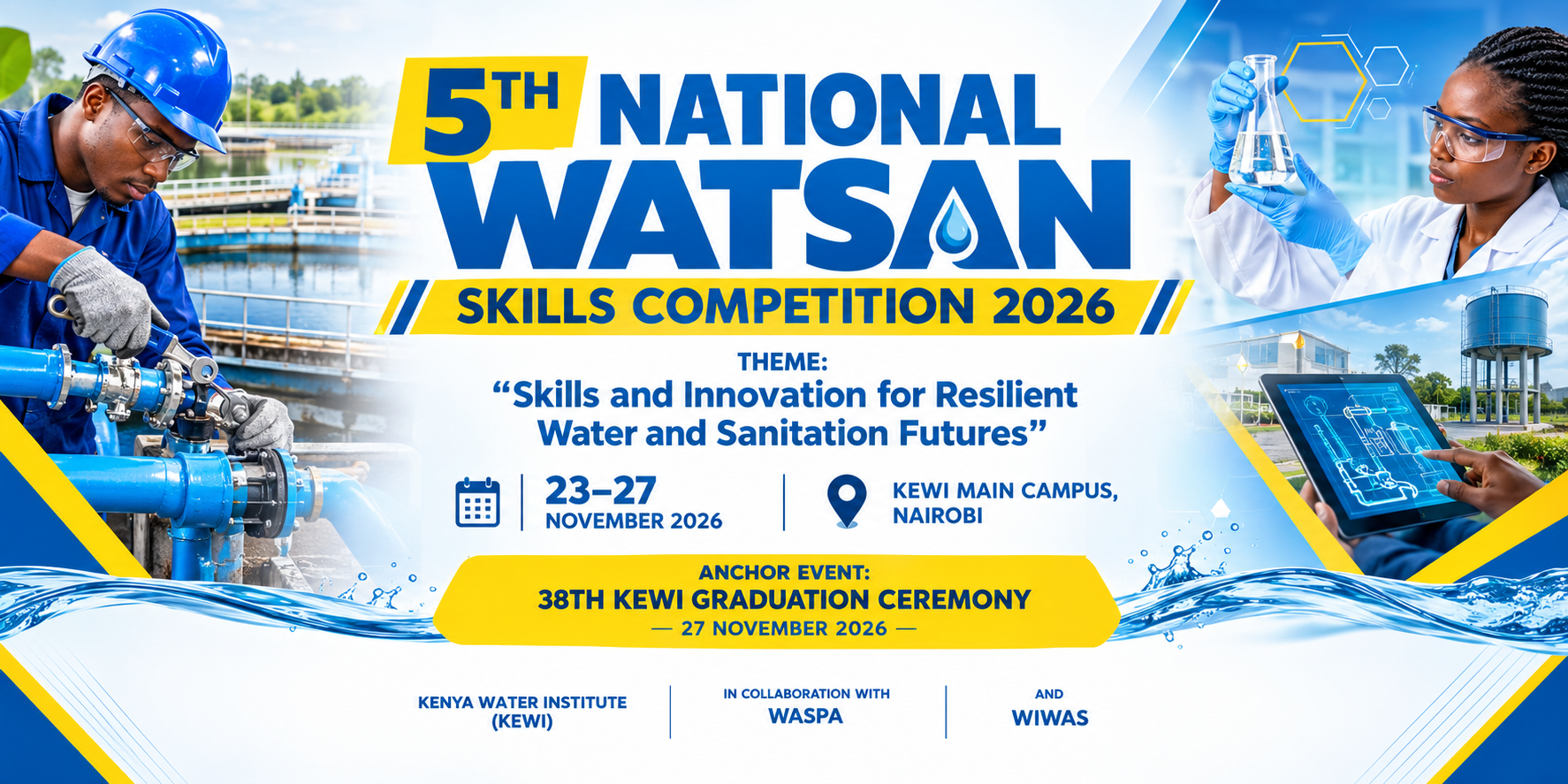
5th National Water and Sanitation (WATSAN) Skills Competition 2026
Theme: Skills and Innovation for Resilient Water and Sanitation Future
About the Competition
The Kenya Water Institute (KEWI), in collaboration with the Ministry of Water, Sanitation and Irrigation (MWSI), Water and Sanitation Providers Association (WASPA), Women in Water and Sanitation Association (WIWAS), Water Service Providers, training institutions, industry and other stakeholders, is organizing the 5th National Water and Sanitation (WATSAN) Skills Competition 2026.
It is a national platform for demonstrating practical competence, innovation, professional excellence and industry relevance in the water and sanitation sector. The competition will progressively align with the WorldSkills approach through occupational standards, practical test projects, industry relevance, transparent assessment and continuous improvement. It will strengthen linkages among WSPs, training institutions and industry and promote Competency-Based Education and Training (CBET).
Date :
23rd–27th
November 2026
Venue
KEWI Main Campus,
South C, Nairobi
Anchor Event
38th KEWI Graduation Ceremony,
27th November 2026
Objectives of the Competition
- Demonstrate and assess practical competencies in water and sanitation operations
- Benchmark sector skills against national and international best practices
- Promote innovation, creativity and technological application
- Identify and recognize outstanding water and sanitation talent
- Promote safe, efficient and environmentally sustainable work practices
- Enhance participation of women and youth in technical careers
- Generate recommendations for continuous improvement of skills development
- Foster collaboration among WSPs, learning institutions, industry and partners

Competition Areas
Water Treatment
- Jar testing
- Coagulation
- Flocculation
- Filtration
- Process control
Water Quality
- Sampling
- Laboratory analysis
- QA/QC
- Interpretation of results
Non-Revenue Water
- Water losses
- Metering
- Leak detection
- NRW management
Plumbing & Metering
- Installation
- Repair
- Testing
- Maintenance
Water Distribution
- Leak detection
- Network operation
- Maintenance
Chlorination & Water Safety
- Chlorine dosing
- Residual chlorine
- Disinfection
- Safety
Sanitation & Wastewater
- Sewered and non-sewered sanitation
- Wastewater treatment
- Effluent monitoring
Innovation, Creativity & Technology
- Innovative solutions to sector challenges
Digital & Simulation Skills
- Digital tools
- Simulation technologies

Competiting Categories
KEWI Junior Primary Water Awareness Programme
- The category is for pupils aged 10-12 (CBC Grades 5-7, Upper Primary and entry Junior School).
- It is the observer tier, not a competition category.
- It runs alongside the KEWI Junior Water Technology Skills Challenge (ages 14-18).
Junior Primary Water Awareness Programme
- For pupils aged 10-12.
- Tap a heading to open and view each tab.
Role of pupils
Structured observers. They watch the older candidates work and record what they see. No hands-on tasks.
Purpose
A safe first look at water technology as a career. It builds observation and curiosity.
Pathway: Junior Primary observer, then Senior Challenge candidate, then TVET/WorldSkills competitor.
Format
An Observation Trail of 7 viewing stations. Pupils go in groups of 4-5 with one adult chaperone.
Time per station
About 12 minutes: 2 to explain, 8 to watch and discuss, 2 for the worksheet.
Duration
About 2 hours, inside the Senior Challenge schedule, at the same venue on the same day.
Assessment
Formative only. No scores or rankings.
Feedback uses the four CBC bands: Exceed (EE), Meet (ME), Approach (AE), Below Expectation (BE).
CBC links
Communication and Collaboration Critical Thinking Citizenship Digital Literacy Learning to Learn Self-Efficacy
Also covers environmental, health and safety education.
Reward
Entry Requirements
- Age and grade: Ages 10-12, in CBC Grades 5-7.
- Consent: A signed parental/guardian consent and media-release form for every pupil.
- Supervision: Pupils join in groups of 4-5 with one chaperone. This is usually arranged through a school trip or open day.
- Identification: Each pupil wears a wristband, sticker or lanyard so facilitators can tell observers from Senior candidates.
- Conduct: Pupils must stay behind the viewing line (at least 1.5 m back). They must not touch any tool, kit, sample, chemical, circuit or filter material, and they must observe quietly.
- Prior skills: None are needed, because pupils only watch and record.
- Tasks
Tasks
Pupils complete one worksheet task at each station:
| Station | What pupils observe | Pupil task |
|---|---|---|
| A: Getting Ready Safely | A candidate putting on PPE and checking tools | Tick the safety items worn (gloves, goggles, apron) |
| B: Telling the Community | A candidate making a poster and practising a spoken message | Circle the single most important message |
| C: Testing the Water | A candidate using a test strip, tube or tablet | Match the test kit to what it measures |
| D: Powering the Pump | A candidate building a battery, switch and motor circuit | Label the three main circuit parts |
| E: Building a Filter | A candidate layering cloth, sand, gravel and charcoal in a bottle | Put the filter layers in the correct order |
| F: Recording the Results | A candidate entering results into a tablet or laptop | Count the results entered and write the number |
| G: Writing It Down | A candidate keeping a written logbook | Write one sentence about what you noticed |
- Application Deadline
Each participating team or category nominates two (2) participants and one technical expert.
At the end there is a group debrief where each pupil can share one thing that surprised them.
- Application Deadline
Each participating team or category nominates two (2) participants and one technical expert.
At the end there is a group debrief where each pupil can share one thing that surprised them.
KEWI Senior Primary Water Technology Skills Challenge
The category is the Senior Water Technology Skills Challenge (Test Project) for Senior School learners aged 14-18 (CBC Grades 10-12). This is the competing tier, where candidates carry out the practical tasks themselves. The file’s own title says “Senior Primary”, but its content, ages and grades are Senior School, so that wording looks like a typo.
- Introduction
Information about the category
- Purpose: A safe, scaled-down practical introduction to the water and wastewater trade. It gives learners a hands-on taste of the career pathway and builds habits of safe working, teamwork, communication and documentation.
- Standards: Aligned to the CBC STEM Pathway and adapted from the WorldSkills Occupational Standards (WSOS) for Water Technology. The adapted weightings keep the WSOS profile but put more emphasis on safety, communication and documentation.
- Format: Individual or pairs, as a single 6-hour day or two 3-hour sessions.
- Scoring: 100 marks, with a rubric-based ranking for Skills Day or competition use.
- Bands:
- EE: 80-100 marks
- ME: 60-79 marks
- AE: 40-59 marks
- BE: below 40 marks
- Venues: KEWI open days, county or regional CBC Skills Days, career-guidance events, or classroom STEM activities.
- Scenario: Furaha Primary School’s borehole has not been tested in months and pupils have had stomach upsets. Candidates act as a Junior Water Technician team and must test the water, build a filter, build a pump circuit, and record and communicate the results.
- Safety limits: Only pre-screened demonstration samples, battery-powered low-voltage circuits (no mains), and no sharp tools handled by candidates.
- Recognition: Every candidate gets a certificate of participation, with extra recognition for the top three if run as a competition.
- Entry Requirement
Entry requirements
The document has no formal eligibility section. These are the requirements stated or implied:
- Age and grade: Ages 14-18, in Senior School Grades 10-12. Grades 8-9 can take part as a secondary fit, as career exposure.
- Prior experience: None required. The project is designed for learners with no prior trade experience.
- Team size: Individual or pairs.
- Consent: A signed parental/guardian consent and media-release form is recommended for all minors.
- PPE: Gloves, goggles and an apron are compulsory for Modules C, D and E, and an adult checks them before work begins.
- Risk assessment: A signed-off risk assessment is needed before moving to Module C or D.
- Conduct: No internet browsing, and demonstration water must never be tasted or drunk.
- Supervision: One adult facilitator per 6 learners, with an adult directly at every electrical and water-testing station.
- Tasks
Tasks (7 modules, 100 marks)
| Module | Marks | Time | Main tasks |
|---|---|---|---|
| A: Work Organisation and Safety | 10 | 30 min | Check the kit, put on PPE, complete the Risk Assessment Worksheet, tidy the station, and clean up at the end |
| B: Communication | 10 | 45 min | Pick the 3 key points, design an A3 poster or leaflet, and give a 2-minute spoken hand-over to the assessor |
| C: Water Quality Field Testing | 20 | 60 min | Test 2 samples (borehole and rainwater tank) for pH, turbidity and residual chlorine, then mark Pass/Fail against guidelines |
| D: Low-Voltage Electrical Circuit | 10 | 45 min | Build a battery, switch and DC motor/pump circuit on a breadboard, test it, and sketch the diagram |
| E: Mechanical Filtration Build | 15 | 45 min | Layer cloth, gravel, sand and charcoal in a cut bottle, filter turbid water, compare before and after, and explain each layer |
| F: Digital Data Logging | 15 | 40 min | Enter Module C results in a spreadsheet template, compare the samples with a formula or chart, and save the file under the given name |
| G: Documentation and Reflection | 5 | Ongoing + 15 min | Keep the Learner Logbook and write a 3-5 sentence reflection |
| H&S conduct | 15 | Whole day | Scored by the assessor as a running observation, not as a separate task |
Guideline values used in Module C:
- pH: 6.5-8.5
- Turbidity: 5 NTU or less
- Residual chlorine: 0.2-0.5 mg/L
- Application Deadline
Each participating team or category nominates two (2) participants and one technical expert.
KEWI National TVET Water Technology Skills Competition, Test Project 2026
The category is the National TVET Water Technology Skills Competition (2026 edition), for TVET Certificate/Diploma candidates. It is the top tier of the pipeline, above the Junior Primary observers and the Senior Challenge. The project is titled Water Quality, Treatment and Pump Systems.
Information about the category
- Candidates: TVET certificate/diploma students in Water/Wastewater Technology, Plumbing or related technical programmes.
- Edition and format: The 2026 edition, for the October 2026 national competition. It is an individual practical competition over two days, with about 13 hours of scheduled working time.
- Standards: Aligned to the WorldSkills Occupational Standards (WSOS) for Water Technology (Lyon 2024 edition) and to the Kenya TVET CBET framework.
- Marks: 100 marks. Chemical/biological and mechanical are each 5 marks above their WSOS weighting, which is the most WorldSkills allows. Electrical (10%) is not assessed because the equipment list has no electrical or PLC equipment.
- Outcome: There are two results.
- Ranking: Candidates are ranked on their total out of 100.
- CBET decision:
- Competent (C): 50 marks or more AND no critical safety breach.
- Not Yet Competent (NYC): below 50 marks, OR a critical safety breach at any stage.
- Equipment: Only the listed station equipment is allowed. It covers analytical instruments (pH, turbidity and colour meters, chlorine comparator, thermometer, timer), jar-test gear, chlorination gear, a PPR welding machine and hand tools, a pump system, and PPE.
- Not assessed: Electrical work, automation and PLC, and microbiological analysis.
- Scenario: Kimuri Water Supply has complaints of cloudy water and inconsistent pressure. The candidate is the assigned Water Technician.
- Marking: Criteria are either M (measured against assessor reference values) or J (judged against performance levels). Marks are Full, Partial or Zero.
- Critical safety failures: These include deliberate unsafe use of the PPR welder, serious chemical or chlorine exposure caused by ignoring instructions, and energising the pump without the assessor’s release. Any of these gives NYC.
- Entry Requirement
Entry requirements
The document has no formal eligibility section. These are the requirements stated or implied:
- Who can enter: TVET certificate/diploma students in Water/Wastewater Technology, Plumbing or related technical programmes.
- Entry mode: Individual only.
- Equipment: Candidates may use only the listed station equipment. No additional technical equipment is permitted for scoring.
- PPE: Lab coat, gloves, safety goggles, helmet, dust coat, anti-slip boots and safety trousers, selected and worn for each task.
- Safety: A task-specific risk assessment before practical work starts. Candidates must also confirm pump isolation with the assessor and wait for the assessor’s release before energising the pump.
- Standards: Candidates are not expected to memorise standards. The assessor supplies the reference limits and test instructions.
- Competence pass mark: 50 or more marks and no critical safety breach.
- Attendance: Both competition days.
- Tasks
Tasks (8 modules, 100 marks)
| Module | Area | Marks | Main tasks |
|---|---|---|---|
| 1 | Work organisation and management | 10 | Check equipment, wear PPE, prepare a job plan, arrange the workstation, and restore equipment after each task |
| 2 | Communication and interpersonal skills | 5 | Write a technical summary, explain the pump work in plain language, and answer two assessor questions (30 min) |
| 3 | Health and safety | 10 | Complete a task-specific risk assessment, use PPE correctly, handle chemicals, chlorine, the PPR welder and pump safely, and keep the area dry and orderly |
| 4 | Environment protection and sustainability | 10 | Calculate coagulant and chlorine doses, segregate waste, run a static pressure-hold water-loss check, state a chlorine spill response, and apply waste-reduction measures |
| 5 | Water quality analysis | 10 | Label samples, calibrate instruments, then measure pH, turbidity, colour, temperature and chlorine, and record and interpret the results |
| 6 | Water treatment | 20 | 6A (12 marks): Six-beaker jar test: dose, mix, settle, measure, and justify the best condition. 6B (8 marks): Chlorination: dose with the TenSette pipet, allow contact time, measure residual chlorine, and select the acceptable condition |
| 7 | Pump installation and PPR pipework | 20 | Inspect components, plan the flow, cut and weld PPR pipe, install the non-return valve, meter, gauge and gate valve, connect the pump, leak-test, and correct an assessor-introduced fault |
| 8 | Instrumentation, manual control and documentation | 15 | Read the gauge and meter and calculate flow rate, regulate manually with the gate valve to the target band, record three valve settings, keep the logbook, and submit a final report (20 min) |
Schedule:
- Day 1: Water quality and treatment (Modules 1, 3, 5, 6, plus parts of 4 and 8).
- Day 2: Pump installation, water-loss check, manual regulation, communication and the final report (Modules 7, 4, 8, 3 and 2).
- Application Deadline
Each participating team or category nominates two (2) participants and one technical expert.
5th National WATSAN Skills and Innovation Competition 2026: University Challenge
Category
The category is the University Challenge of the 5th National WATSAN Skills and Innovation Competition 2026. It is for undergraduate engineering students and is the highest academic level of the four documents. Its theme is “Skills and Innovation for Resilient Water and Sanitation Future”.
- Introduction
Information about the category
- Organisers: KEWI, with the Ministry of Water, Sanitation and Irrigation, the Water Services Providers Association (WASPA) and Women in Water and Sanitation (WIWAS).
- Purpose: It benchmarks practical, complex problem-solving skills and recognises professional excellence in water and sanitation engineering. Here “practical competence” means applying engineering theory through advanced calculations, dynamic software modelling and professional technical reports. It is not hands-on lab or workshop work.
- Journey: Teams define the problem, complete the engineering calculations, build dynamic software simulations and prepare an optimised technical report. They then defend the solution live before an independent industry panel. The document calls this a “four-phase” journey but lists five elements.
- Benefits:
- benchmarking against national and international standards
- direct links with water service providers and regulators
- data to inform curriculum reviews and CBET implementation
- promotion of female engineering students under the WIWAS mandate
- national trophies, research grants and career pathways
- Software tools named: Spreadsheets, WaterCAD, EPANET, AQUASIM and SIMBA#.
- Scoring: 100 points in total, split as follows:
- Desktop Review: 70 points.
- Engineering analysis and computations: 25
- Dynamic software modelling: 25
- Technical reporting and feasibility: 20
- Live Arena Defense: 30 points.
- Presentation: 10
- Defence of design: 15
- Teamwork: 5
- Desktop Review: 70 points.
- Eight technical streams (a team picks one):
- Water Treatment Engineering
- Wastewater Treatment and Effluent Management
- Faecal Sludge Management and Non-Sewered Sanitation
- Circular Economy and Resource Recovery
- Nature-Based Treatment and Eco-Sanitation
- Digital Twin Modelling, Smart Sanitation and Hydro-Informatics
- Waste-to-Energy Systems and Climate Infrastructure
- Water Safety and Laboratory QA/QC
- Entry Requirement
Entry requirements
- Who can enter: Undergraduate students enrolled in bachelor’s programmes in Civil Engineering, Water and Sanitation Engineering, Environmental Engineering or related disciplines.
- Team size: The call says 2-3 students, including one Team Leader. The registration form says 3-5 members (3 required, 2 optional). This conflict needs clarifying with the Secretariat.
- Team conduct: Clear role distribution, mutual trust and flexibility under time pressure.
- Academic mentor: A full-time academic supervisor who gives technical oversight and verifies authenticity, but does not do the work for the students.
- Institutional approval: Formal endorsement by the Head of Department or Dean, with a signature and stamp. This confirms the students are registered and in good academic standing.
- Originality: The Team Leader signs a declaration that the work is original. Plagiarism or uncredited use of external designs means immediate disqualification.
- Registration:
- Complete the Annex 1 form electronically and submit it as a signed PDF to entries@kewi.ac.ke by 20 October 2026.
- The form covers the institution, mentor, team, one chosen stream, a project abstract of at most 300 words, and the declaration and endorsement.
- The abstract must name the real-world problem, the design parameters and principles, and the software tools to be used.
- Tasks
Tasks and timeline
| Date | Task |
|---|---|
| 7 Oct 2026 | Call released with the 8 streams and design guidelines |
| 20 Oct | Submit registration form and 300-word abstract |
| 21-23 Oct | Pre-qualification screening; approved teams start full design modelling |
| 13 Nov | Submit the Comprehensive Design Package: technical report, engineering calculations and dynamic software models |
| 16-19 Nov | Desktop review by the WASPA/WIWAS expert panel to shortlist finalists |
| 20 Nov | Finalists notified |
| 24-27 Nov | Live Arena Defense at KEWI Main Campus, alongside the 38th KEWI Graduation |
What the design package must show (from the rubric):
- Engineering analysis (25):
- Extract design parameters and constraints from the Terms of Reference (5).
- Do step-by-step analytical computations (10).
- Use realistic, justified assumptions and safety factors (10).
- Software modelling (25):
- Build a correct model with the right components, nodes and flow routing (10).
- Test multiple scenarios and optimise the design (10).
- Interpret simulation outputs under peak and stress conditions (5).
- Reporting and feasibility (20):
- Include a Bill of Quantities, CAPEX/OPEX and lifecycle costs (10).
- Show compliance with Kenyan water regulations, NEMA and SDG 6, plus climate resilience (5).
- Write a clear, well-cited, professional report (5).
Live defence: A 15-minute presentation followed by Q&A with the industry panel. It is scored on presentation clarity (10), defence of the design under unscripted technical questions (15, the key measure) and teamwork (5).
- Application Deadline
Each participating team or category nominates two (2) participants and one technical expert.
KEWI National TVET Skills Competition 2026
Water Technology: Water Quality, Treatment and Pump Systems
Test your skills as a Water Technician. Analyse, treat and disinfect water, then install and test a small pump-and-pipe system. All in two days, all hands-on.
Category of participants
This category is for TVET students who are learning to work with water: its quality, its treatment and its movement through pipes.
Who should enter
TVET certificate and diploma students in:
Water TechnologyWastewater TechnologyPlumbingRelated technical programmes
The project follows the Kenya TVET CBET framework and the WorldSkills Occupational Standards for Water Technology (Lyon 2024 edition).
Format
An individual practical competition. You work alone at your own station.
How you work
- Individual candidate, one station each
- Practical tasks, with written records and a short oral briefing
- Marked on observable performance only
Ranking
Final ranking is by total marks out of 100 among candidates who complete the competition. You also receive the C / NYC decision.
Your station equipment
Duration
Two competition days, about 13 hours of scheduled working time. Day 1 is the water. Day 2 is the pump.
Project modules
Eight modules, 100 marks. Select a module to see what you will be asked to do.
1Work organisation and management
10 marks
Organise your workstation, sequence the work, and manage tools, samples and time.
- Check issued equipment against the station list
- Wear the right PPE before handling samples or chemicals
- Prepare a job plan: analysis, jar test, chlorination, pump work
- Keep the station tidy and restore equipment after each task
2Communication and interpersonal skills
5 marks · 30 min
- Write a short technical summary of your findings and treatment decision
- Explain your pump work and test result in clear, non-technical language
- Answer two assessor questions on why you chose your methods
3Health and safety
10 marks
Work safely throughout. A critical safety failure results in Not Yet Competent.
- Complete a risk assessment before practical work (chemicals, chlorine, glassware, pump, manual handling)
- Use PPE correctly for each task
- Handle chemicals and chlorine following the safety data sheet
- Use the PPR welding machine, tools and pump safely; confirm pump isolation, and wait for the assessor's release before energising
- Keep your area dry, clear and orderly
4Environment protection and sustainability
10 marks
- Calculate coagulant and chlorine volumes from stock concentrations, and record them before dosing
- Segregate and dispose of chemical water, rinse water, used samples and PPR offcuts
- Run a timed static pressure-hold check; use the meter and gauge to detect and locate water loss
- Explain how a chlorine spill would be contained and reported
- Name two ways to reduce waste and apply at least one
5Water quality analysis
10 marks
Measure and interpret the supplied samples against limits the assessor provides.
- Label samples; check or calibrate the pH meter; zero the turbidity and colour meters
- Measure pH, turbidity, apparent colour and temperature; check chlorine where applicable
- Record results with correct units and flag anything outside the acceptance range
6Water treatment: jar test and chlorination
20 marks
6A Jar-test optimisation · 12 marks
- Prepare six 250 mL beakers and dose them accurately
- Run the gang stirrer on the set rapid-mix and slow-mix sequence
- Observe floc formation and settling, then measure the result
- Pick the best condition and justify it
6B Chlorination and disinfection · 8 marks
- Prepare six 118 mL bottles and dose with the TenSette pipet
- Mix on the stir plate, then time the contact period
- Read residual chlorine with the comparator and choose the acceptable condition
- Explain why contact time and dose control matter
7Pump installation and PPR pipework
20 marks
- Inspect all components and plan the flow direction
- Measure, cut and weld PPR pipe into sound joints
- Fit the non-return valve (correct direction), water meter, pressure gauge and gate valve
- Connect the submersible pump securely
- Test for leaks, abnormal pressure or wrong flow
- Find and correct one assessor-introduced fault
- Leave the installation secure and orderly
No electrical wiring or electrical fault-finding is assessed.
8Instrumentation, manual control and documentation
15 marks
- Read the gauge and meter at set intervals and calculate flow rate (volume ÷ time)
- Use the gate valve to reach the assessor's target pressure or flow band
- Record pressure and flow at three valve settings (fully open, partly closed, throttled) and comment on system behaviour
- Keep your logbook and recording sheets up to date
- Submit a concise final report with conclusions and recommendations (20 minutes, Day 2)
How it works
How it works
- Call for participation
- Registration
- Pre-qualification and selection
- Technical briefing
- Practical competition
- Assessment and scoring
- Verification of results
- Awards and recognition
- Post-competition review
How entries are assessed
How entries are assessed
Competitors are assessed against standardized, competency-based criteria:
- Technical competence and practical performance
- Accuracy and quality of work
- Occupational health and safety
- Innovation and problem-solving
- Time management
- Teamwork and professionalism
- Adherence to procedures
Independent judges and assessors are appointed and oriented to ensure fairness, consistency, transparency and credibility.
Pathway to WorldSkills
Pathway to WorldSkills
The competition is progressively aligning with the WorldSkills approach, using occupational standards, practical test projects, clear assessment criteria and independent assessment.
Pathway: institutional and sector competitions, then the National WATSAN Skills Competition, then national benchmarking and talent identification, then WorldSkills Africa and WorldSkills International opportunities. Participation is coordinated through the WorldSkills Kenya national member arrangements.
What the competition delivers
What the competition delivers
- A national platform for water and sanitation skills development
- Improved practical competencies and recognition of outstanding talent
- Greater innovation and technology adoption, with an innovation exhibition
- Stronger partnerships between industry and training institutions
- Greater visibility of women and youth in the sector
- Recommendations for curriculum and workplace skills
Partners and sponsorship
Partners and sponsorship
The competition is a collaboration among the Ministry of Water, Sanitation and Irrigation, KEWI, WASPA, WIWAS, Water Service Providers, training institutions, development partners and the private sector.
Partnership opportunities include technology, institutional support, branding, media and communication, and gender inclusivity.
For registration and partnership enquiries, contact KEWI.