
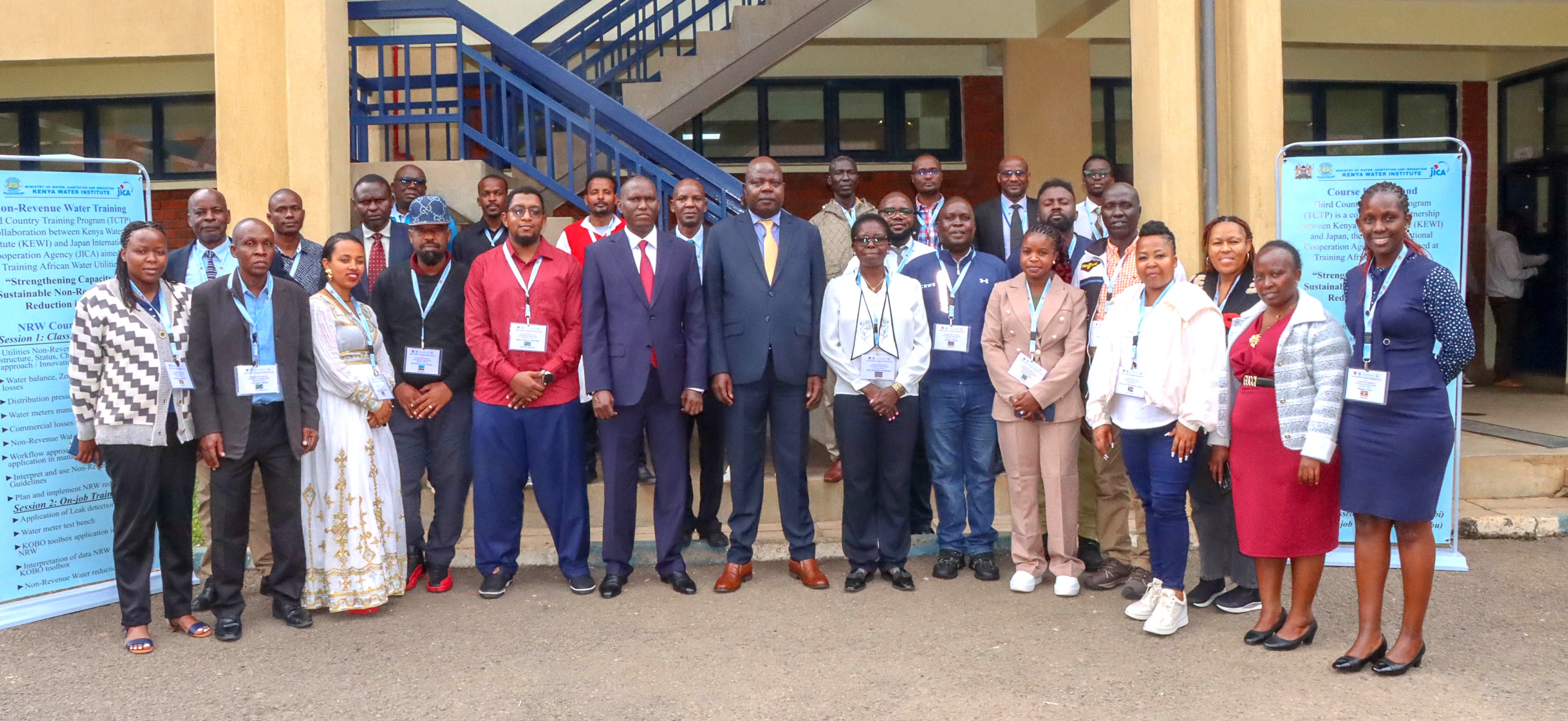
KEWI Hosts Third Phase of Regional Training to Strengthen Africa’s Capacity on Non-Revenue Water
Reducing Non-Revenue Water (NRW) is not just an engineering challenge but a shared responsibility requiring concerted efforts to ensure access to water for every citizen, Water Secretary Engineer S.A.O. Alima has said.
Engineer Alima made the remarks as the Kenya Water Institute (KEWI), in partnership with the Japan International Cooperation Agency (JICA), hosted the third phase of the Third Country Training Program (TCTP) on Strengthening Capacity for Sustainable Water Management in Africa in Nairobi.
The regional training has brought together water sector representatives from Kenya, Uganda, Zanzibar-Tanzania, South Sudan, Ethiopia, Rwanda, Nigeria, Zambia, South Africa and Malawi to exchange experiences and strengthen national approaches to reducing water losses.
The programme provides a platform for participating countries to compare their water and sanitation sector structures, review Non-Revenue Water policies and develop practical country-specific action plans for addressing physical and commercial water losses.
Speaking during the opening of the training, Engineer Alima said urban growth and ageing water infrastructure were among the challenges complicating efforts to reduce NRW, contributing to estimated losses of US$39 billion across the region.
“We therefore, as a community of nations aware of the menace that this issue of NRW is causing, should understand that reducing NRW is not just an engineering aspect but an issue that requires concerted efforts to ensure that water is accessible to every citizen,” he said.
He called on participating countries to translate the knowledge and experiences gained from the programme into policies that would strengthen NRW guidelines, regulatory frameworks and implementation mechanisms in their respective countries.
The training is being conducted at KEWI’s NRW Management Centre of Excellence in Nairobi, where participants are benefiting from specialised facilities, technical expertise and training materials developed through the JICA-KEWI partnership.
Speaking on behalf of JICA Expert Eng. Yasuo Kobayashi, who is assigned to the technical cooperation project on NRW reduction, Kenya JICA representative John Gitau commended KEWI for its role in supporting participating countries to strengthen their capacity in NRW management.
Gitau emphasised the value of preventing water losses, noting that “a litre of water saved is a litre of water delivered.”
The training curriculum covers commercial loss management, including billing analysis, data tracking and proper customer meter installation, as well as physical leakage control through leakage surveys, meter testing and active pressure management.
Participants are also being equipped with standardised monitoring tools, including Kobo Toolbox and NRW Monitoring Sheets, to support systematic tracking of water losses and operational performance.
A key component of the programme is the development of tailored national action plans. Participating countries are expected to identify priority interventions that can be implemented upon their return home, including policy improvements, smart utility management and technological upgrades. Malawi, for instance, is using the programme to build on its recently reviewed NRW Action Plan.
The training also focuses on utility governance, with participants examining how institutional structures and regulatory policies can support effective NRW reduction, improve utility efficiency and strengthen service delivery.
Welcoming the participants to KEWI, Director/CEO Dr. Leiro Letangule, EBS, urged them to maximise the learning opportunities presented by the programme and translate the knowledge gained into practical interventions in their respective countries.
The third phase of the TCTP reinforces KEWI’s role as a regional hub for knowledge exchange, technical capacity development and collaborative solutions to water management challenges across Africa.